Almost Alive
Three robot arms. Three ways of responding to the world. One shared task that none of them can sustain alone.
A small world, kept in motion
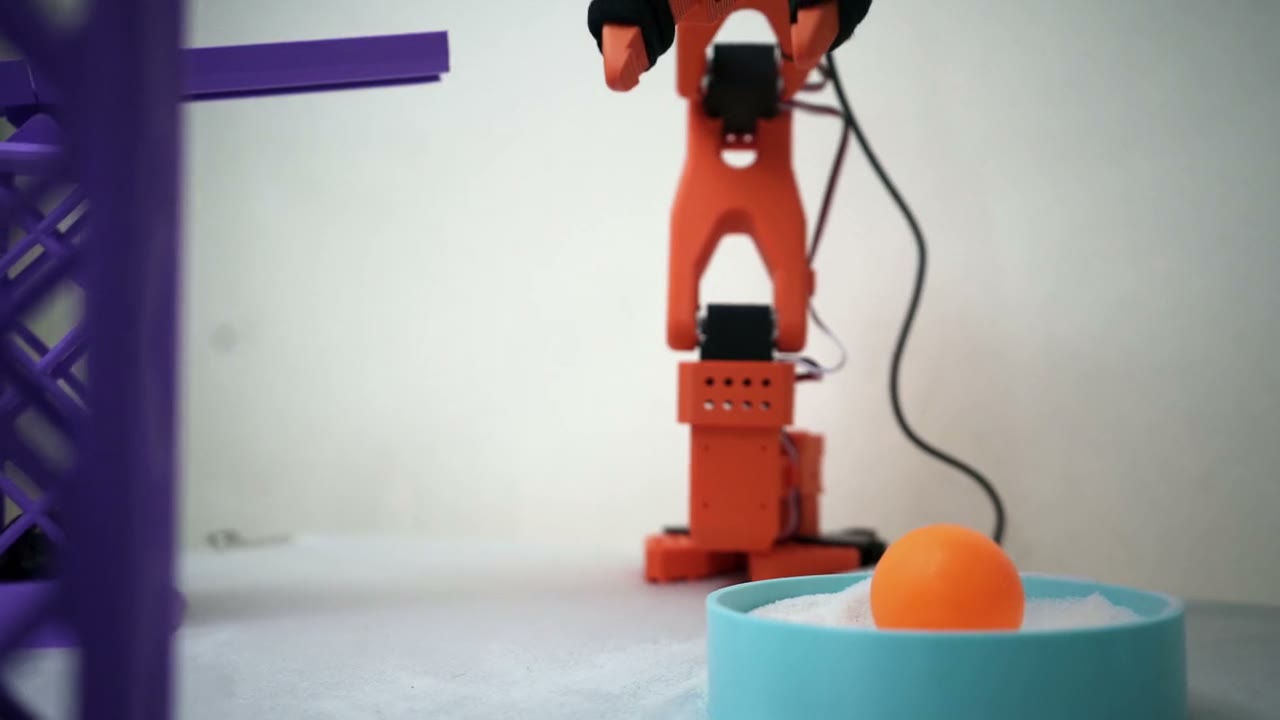
Almost Alive is an early experiment within Liminal Machines. On a small table, three robot arms pass a catch around a loop of tracks, a cup, and a bed of salt. Each arm takes care of one part of the journey. Each depends on the others to make its next move possible.
The arms begin with the same kind of body, but have different ways of perceiving and acting. One repeats a movement. One responds to a visual cue. One learns to adapt from examples. The installation brings these approaches to robotics into the same small world, where their capabilities and limits become visible through a shared task.
Loading the installation…
Echo remembers
Echo lives beside a rocking track, where the catch always arrives in the same place. Its world is predictable, so it needs no camera. We gave it one movement, and it repeats that movement each time the catch comes around.
But Echo cannot tell when to begin. It waits for a neighbour’s signal before tipping the track and sending the catch back into the salt. Its ability is narrow, and the world around it makes that ability enough.
Echo represents the familiar robot that repeats a practised action in a controlled setting. The process page shows how its recorded gesture and trigger work.
Iris watches
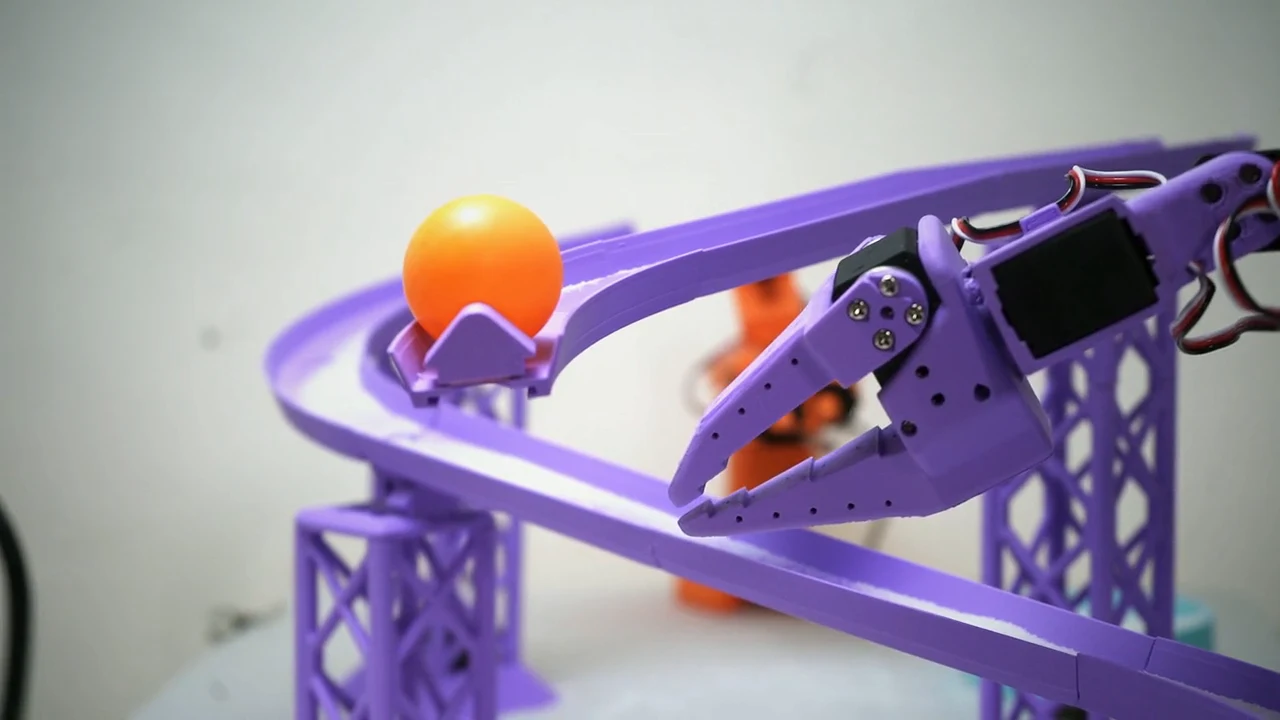
Iris also knows where the catch will arrive, but not when. It watches the foot of the track for something orange and round. When the catch appears, Iris catches it in a cup and tips it onto Echo’s track. The turn of its wrist is Echo’s cue to start.
Seeing gives Iris a way to respond to timing, while its movement stays familiar. It does not need to learn a new reach on each pass: it needs to know when the world is ready. We document the visual rule and handoff in the process.
Bandit learns
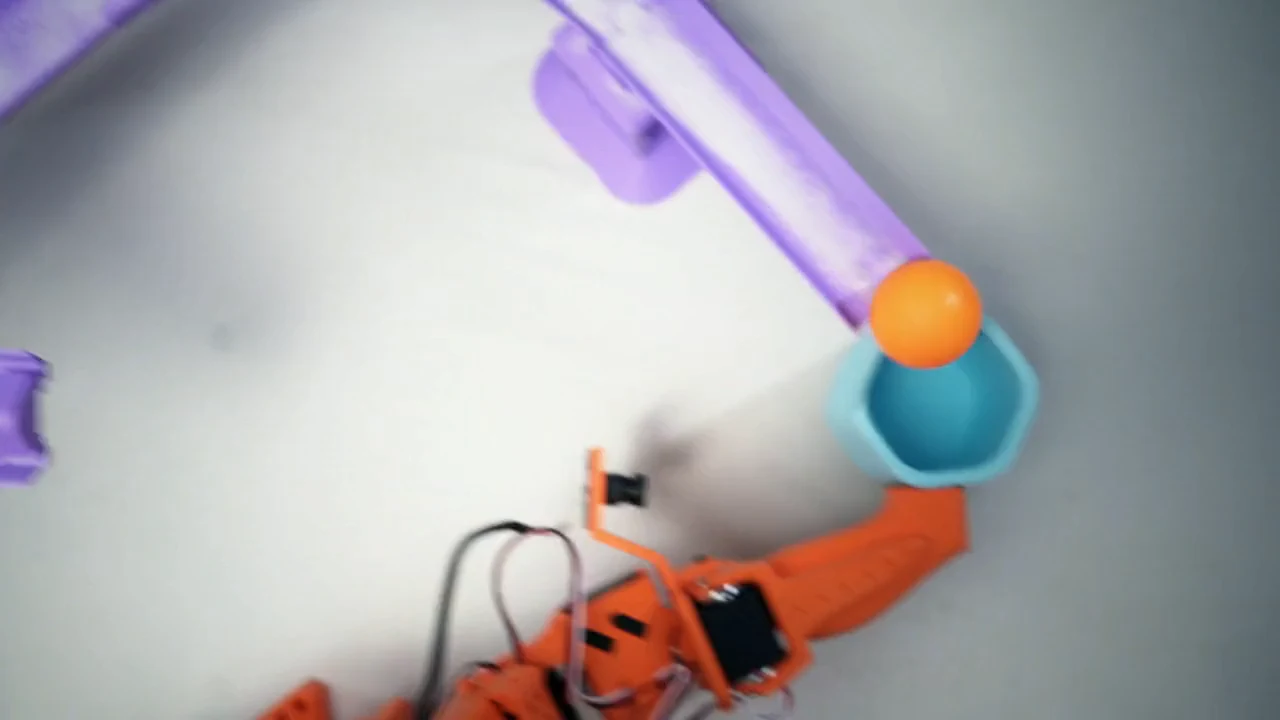
Bandit has the least predictable part of the installation. The catch lands somewhere new in the salt on each lap. A movement that worked once could close on empty space the next time.
Instead of giving Bandit a fixed reach, we guided it through examples with a leader arm. A learned model connects what its cameras see with how it moves. Now Bandit looks for the catch, picks it up, and returns it to the upper track. It sometimes pauses, misses, or tries again. Learning makes it more adaptable; it does not make it unlimited.
The process follows the demonstrations and learned pickup, from recording the examples to studying the model’s predictions.
Together, a different kind of ability
Remembering, seeing, and learning describe different ways for a robot to meet its surroundings. Their differences lie in what they can sense, how they choose a movement, and how much variation they can handle. Each arm has just enough capability for its role, and needs the other arms to keep that role possible.
On its own, each would eventually wait. Together, each one’s action becomes the next one’s cue. A simple exchange becomes a continuing activity that belongs to the whole installation.
Almost Alive explores what happens when we spend time watching that relationship. A pause can look like hesitation; a repeated gesture can become a habit. The arms are not alive, yet their shared rhythm invites us to read intention and character into them. It is a small starting point for imagining how machines with different abilities might share a world with us.